Parts of speech are categories that define the grammatical functions of words within a sentence. They help convey the role each word plays in the structure of a sentence. Understanding it is fundamental to constructing grammatically correct sentences and communicating effectively in English. Each part of speech serves a specific role in conveying meaning and structure within the language.
Definition: A noun is a word that represents a person, place, thing, or idea.
Example: “cat,” “London,” “friendship.”
Pronoun:
Definition: A pronoun is a word that takes the place of a noun in a sentence.
Example: “he,” “she,” “it,” “they.”
Verb:
Definition: A verb is a word that expresses action or a state of being.
Example: “run,” “eat,” “is,” “am.”
Adjective:
Definition: An adjective is a word that describes or modifies a noun or pronoun.
Example: “happy,” “blue,” “tall.”
Adverb:
Definition: An adverb is a word that modifies a verb, adjective, or other adverb, providing additional information about the manner, place, time, or degree.
Example: “quickly,” “very,” “here.”
Preposition:
Definition: A preposition is a word that shows the relationship between a noun (or pronoun) and other elements in the sentence.
Example: “on,” “under,” “in.”
Conjunction:
Definition: A conjunction is a word that connects words, phrases, or clauses.
Example: “and,” “but,” “or.”
Interjection:
Definition: An interjection is a word or phrase used to express strong emotion or surprise.
Example: “Oh!” “Wow!” “Alas!”
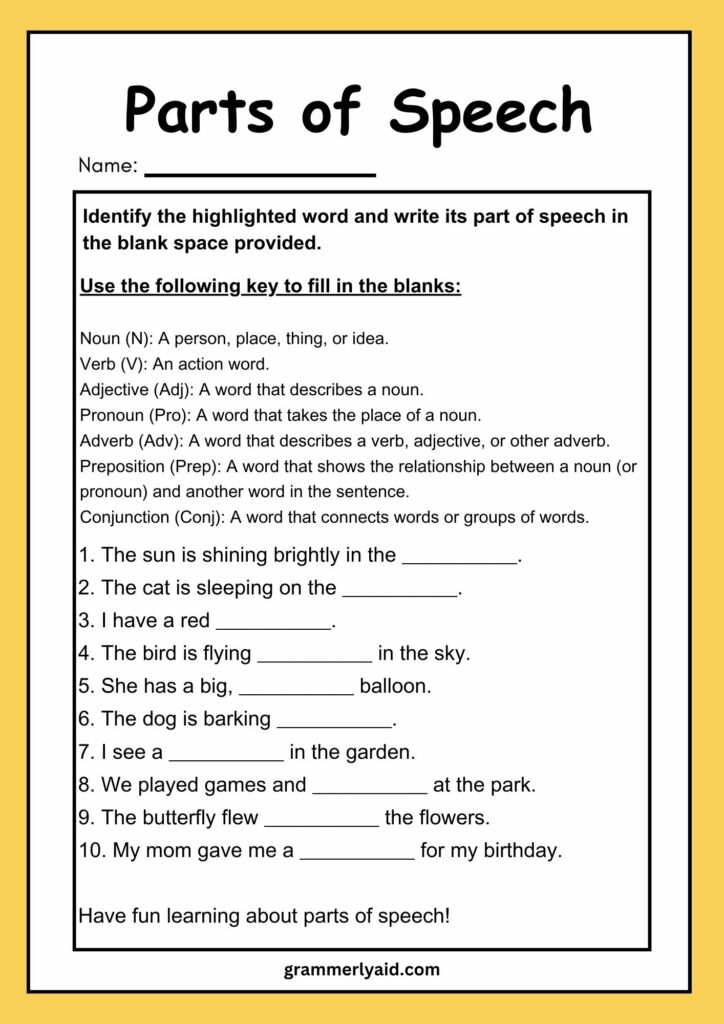
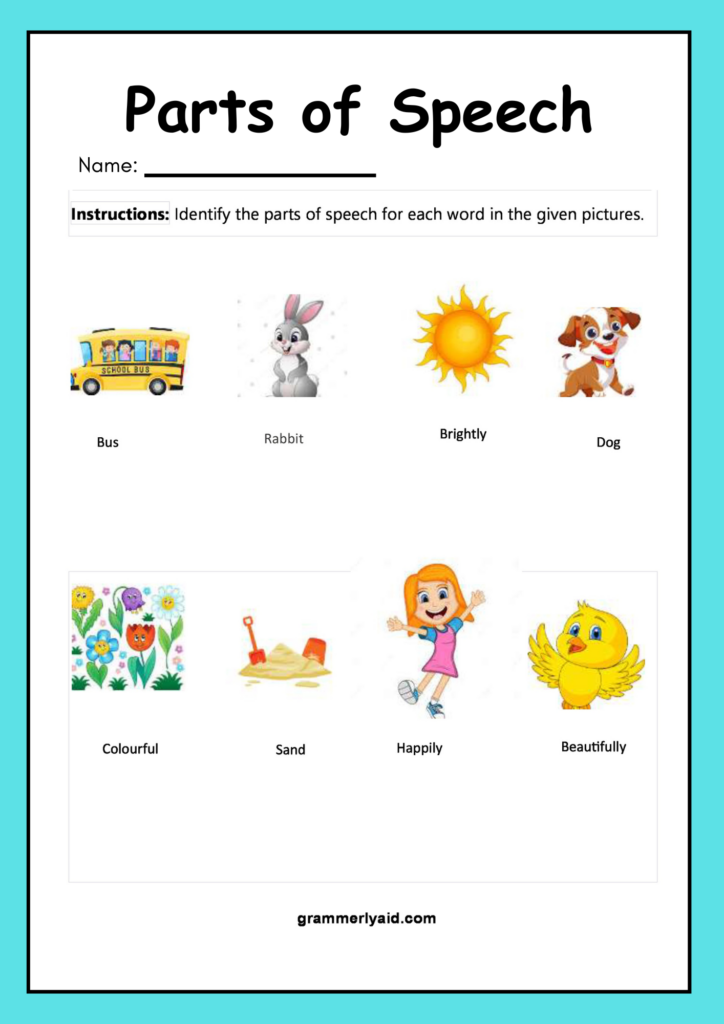
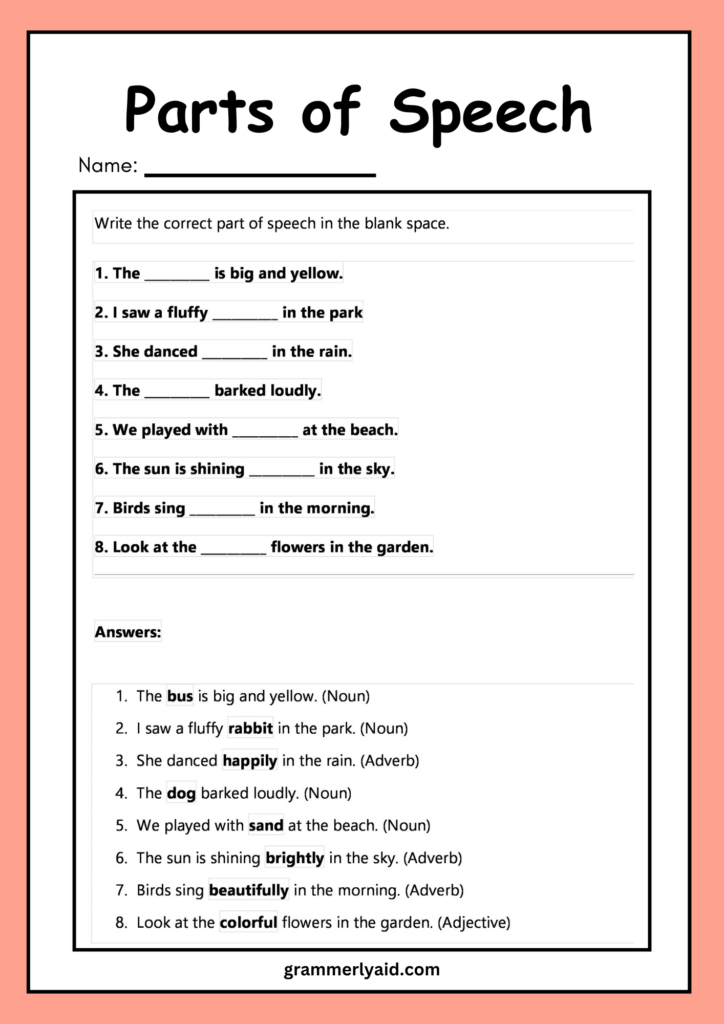
Worksheet for practice:
Easy methods of learning parts of speech:
Colour-Coding:
Use different colours to highlight or underline each part of speech in sentences or texts. This visual aid helps reinforce the association between colours and parts of speech.
Interactive Games:
Play games that involve identifying parts of speech. Board games, card games, or online games can make learning more enjoyable and interactive.
Storytelling:
Create stories or sentences that include examples of each part of speech. This method allows for a contextual understanding of how each part functions.
Songs and Rhymes:
Set parts of speech to catchy tunes or rhymes. Singing or reciting rhymes can make the information more memorable.
Flashcards:
Create flashcards with a part of speech on one side and examples or definitions on the other. Quiz yourself regularly to reinforce learning.
Use Real-Life Examples:
Identify parts of speech in everyday conversations, books, or articles. Real-life examples help connect theoretical knowledge to practical usage.
Grouping Activities:
Group words based on their parts of speech. Create visual charts or posters that categorize words into nouns, verbs, adjectives, etc.
Drawing or Picturing Words:
Illustrate words or sentences to represent different parts of speech. Drawing visual representations can aid in memorization.
Role Play:
Act out sentences or scenarios that involve different parts of speech. This kinesthetic approach can help reinforce understanding.
Technology-Based Learning:
Explore online resources, apps, or interactive websites that gamify parts of speech learning. Many platforms offer engaging exercises and quizzes.
Create a Parts of Speech Handbook:
Develop a personal handbook or reference guide with examples and explanations for each part of the speech. Organize it in a way that is easy to navigate and review.
Teach Others:
Teach the concept of parts of speech to someone else. Teaching others reinforces your understanding and helps you remember the information better.
Connect with Hobbies:
Relate parts of speech to hobbies or interests. For example, identify parts of speech in sports commentary, lyrics of favourite songs, or descriptions of hobbies.
Mnemonic Devices:
Create mnemonic devices or memory aids for each part of speech. For example, “Noun is a name.” Think of “Verbs are action words” or “Adjectives” as words that add “descriptions” to nouns.