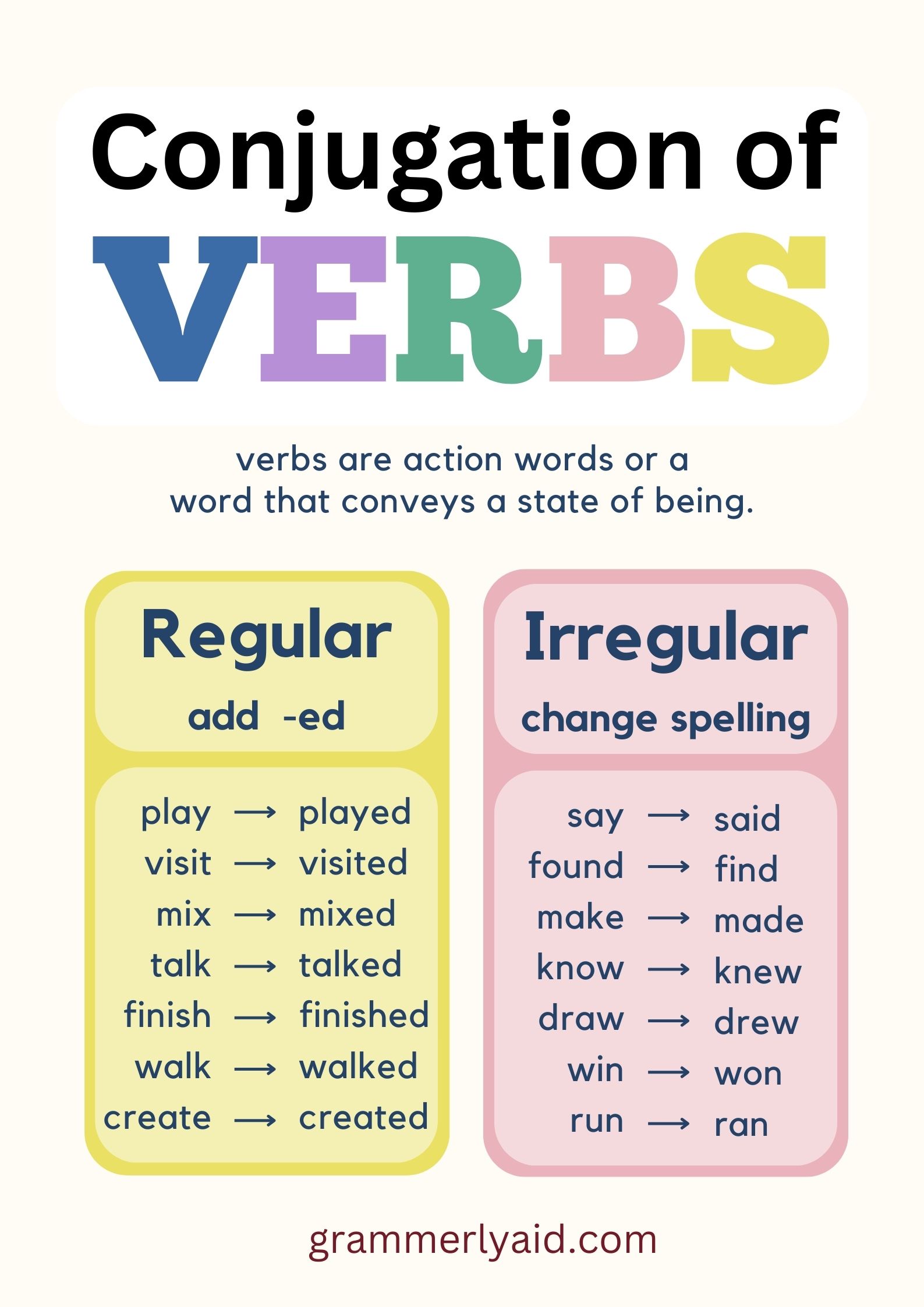
The Best Way to learn Conjugation of Verbs: A Kid’s Guide!
Verbs are like the superheroes of our sentences. They show action, express states of being, and help us communicate effectively. But did you know that verbs can change form depending on who is doing the action and when it’s happening? This magical transformation is called verb conjugation, and today, we’re going to explore it in detail!
Verb conjugation is the process of changing a verb to match the subject of a sentence, as well as its tense (when the action happens). In simpler terms, it’s like giving the verb a different costume depending on who’s using it and when they’re using it.
Kinds of conjugation of verbs:
There are two main kinds of conjugation of verbs-
Weak verbs or Regular verbs
Strong verbs or Irregular verbs
Weak verbs or Regular verbs
Verbs that form their past tense by adding -ed, -d or -t to the present, with or without any inside change are called weak or regular verbs.
Regular Verb Example:
Infinitive: to play
Present Tense: I play, you play, he/she/it plays, we play, they play
Past Tense: I played, you played, he/she/it played, we played, they played.
Conjugation of Regular Verbs to Form Simple Past and past participle
1)We often add -ed to verbs (regular verbs) to make the past simple and past participle:
Regular verbs
simple past
past participle
add
add
added
allow
allowed
allowed
appear
appeared
appeared
ask
asked
asked
boil
boiled
boiled
borrow
borrowed
borrowed
cheer
cheered
cheered
clean
cleaned
cleaned
climb
climbed
climbed
delay
delayed
delayed
discuss
discussed
discussed
dream
dreamed
dreamed
end
ended
ended
enjoy
enjoyed
enjoyed
fail
failed
failed
fill
filled
filled
hang
hanged
hanged
jump
jumped
jumped
look
looked
looked
2) We often add -d only if a verb ends in -e to make the past simple and past participle:
Regular verbs
simple past
past participle
agree
agreed
agreed
close
closed
closed
divide
divided
divided
hope
hoped
hoped
lie
lied
lied
die
died
died
loose
loosed
loosed
love
loved
loved
place
placed
placed
complete
completed
completed
change
changed
changed
compare
compared
compared
care
cared
cared
dare
dared
dared
dance
danced
danced
arrange
arranged
arranged
divide
divided
divided
gaze
gazed
gazed
charge
charged
charged
3)If a verb ends in consonant -y, change -y to -i and add -ed to make the past simple and past participle:
Regular verbs
Simple past
Past participle
bury
buried
buried
carry
carried
carried
cry
cried
cried
dry
dried
dried
fry
fried
fried
try
tried
tried
hurry
hurried
hurried
marry
married
married
lay
laid
laid
pay
paid
paid
say
said
said
marry
married
married
multiply
multiplied
multiplied
identify
identified
identified
4)If a verb ends in a consonant-vowel-consonant (CVC) pattern, double the final consonant and add -ed.
Regular verbs
past form
past participle
beg
begged
begged
drop
dropped
dropped
hop
hopped
hopped
emit
emitted
emitted
nod
nodded
nodded
pat
patted
patted
plan
planned
planned
refer
referred
referred
rub
rubbed
rubbed
stop
stopped
stopped
travel
travelled
travelled
quarrel
quarreled
quarreled
5) Make verb by making some changes or adding -t
Regular verbs
Past from
Past participle
bend
bent
bent
build
built
built
burn
burnt
burnt
buy
bought
bought
catch
caught
caught
fight
fought
fought
deal
dealt
dealt
dream
dreamt
dreamt
dwell
dwelt
dwelt
feel
felt
felt
keep
kept
kept
kneel
knelt
knelt
learn
learnt
learnt
leave
left l
left
lend
lent
lent
lose
lost
lost
mean
meant
meant
seek
sought
sought
send
sent
sent
sleep
slept
slept
smell
smelt
smelt
spell
spelt
spelt
spend
spent
spent
sweep
swept
swept
teach
taught
taught
think
thought
thought
Strong verbs or Irregular verbs
A strong verb, also known as an irregular verb, is a verb in which the past tense is formed by a change in the vowel of the verb root, rather than by adding -ed or -d to the end of the word as in regular verbs. These verbs typically don’t follow a consistent pattern in their conjugation, and their past tense forms often need to be memorized.
Subject Agreement: Verbs must agree with their subjects in number (singular or plural). If the subject is singular, the verb form will be different from when the subject is plural.
Example:
Singular: The cat jumps.
Plural: The cats jump.
Tense: Verbs can also change based on when the action is happening. There are three main tenses: past, present, and future.
Present Tense: Actions happening now.
Example: The bird sings.
Past Tense: Actions that have already happened.
Example: The dog barked.
Future Tense: Actions that will happen later.
Example: The sun will shine.
Regular vs. Irregular Verbs: Most verbs follow a pattern when conjugated, but some don’t! Regular verbs follow a predictable pattern when changing form, while irregular verbs have unique forms for each tense.
Regular Verb Example:
Infinitive: to play
Present Tense: I play, you play, he/she/it plays, we play, they play
Past Tense: I played, you played, he/she/it played, we played, they played
Irregular Verb Example:
Infinitive: to go
Present Tense: I go, you go, he/she/it goes, we go, they go
Past Tense: I went, you went, he/she/it went, we went, they went
Now that we’ve learned the rules, let’s practice a bit:
Fill in the blanks with the correct form of the verb:
Yesterday, she ___________ (eat) a delicious cake.
We ___________ (swim) in the pool every summer.
The flowers ___________ (bloom) beautifully in spring.
Identify the tense of the following sentences:
They will go to the park tomorrow. (Future Tense)
She dances gracefully on stage. (Present Tense)
He finished his homework last night. (Past Tense)
Worksheet 1: Regular Verbs
Directions: Identify the regular verbs in the sentences below. Circle the regular verbs.
The cat __________ (jump) onto the chair.
We always __________ (play) soccer in the park.
She __________ (read) a book every night.
The sun __________ (shine) brightly in the sky.
I __________ (bake) cookies for the school party.
Worksheet 2: Irregular Verbs
Directions: Fill in the blanks with the correct form of the irregular verbs given in brackets.
Yesterday, I __________ (go) to the zoo and __________ (see) a giraffe.
We __________ (eat) dinner at Grandma’s house last night.
The children __________ (swim) in the pool for hours.
She __________ (run) so fast that she __________ (win) the race.
My dog __________ (dig) a hole in the backyard and __________ (hide) his bone.
Conclusion:
Understanding verb conjugation is like unlocking a secret code in language. By mastering how verbs change to fit different situations, you’ll be able to express yourself more clearly and confidently. So, keep practicing, and soon you’ll be a verb conjugation superhero too!