Concrete and Abstract Nouns: Differences, Examples, and Usage
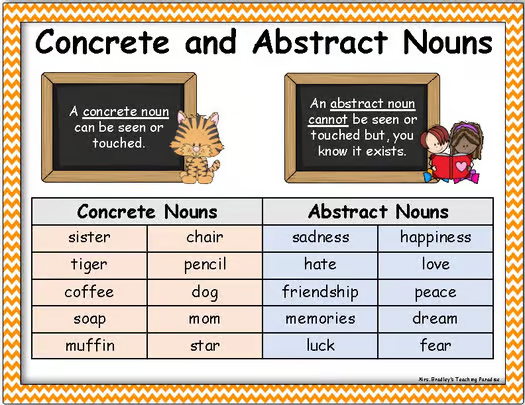
Concrete nouns are words for tangible objects that can be experienced through the senses—things we can touch, taste, smell, see, or hear. In contrast, abstract nouns represent intangible concepts, ideas, or qualities that cannot be experienced directly through the senses or physically touched in the world around us.
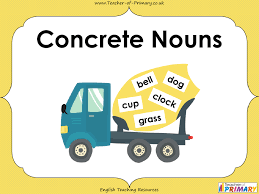
Concrete nouns refer to things that can be perceived through the five senses: sight, hearing, taste, touch, and smell. In other words, if you can experience it physically, it is likely a concrete noun. Concrete nouns usually represent tangible items such as objects, people, animals, and places.
Examples of Concrete Nouns:
People: teacher, firefighter, friend, doctor
Animals: cat, dog, elephant, tiger
Objects: car, book, phone, building
Places: beach, library, school, city
Food and Drink: pizza, apple, coffee, cake
Characteristics of Concrete Nouns:
Tangibility: Concrete nouns represent objects that have a physical form, making them perceptible to the senses.
Countable or Uncountable: Concrete nouns can be either countable (e.g., “book” or “tree”) or uncountable (e.g., “water” or “sand”).
Pluralization: Most concrete nouns can be pluralized if they’re countable (e.g., “dogs,” “cars”), while uncountable nouns generally do not have a plural form (e.g., “salt”).
Common vs. Proper: Concrete nouns can be common nouns (general names like “city” or “animal”) or proper nouns (specific names like “New York” or “Eiffel Tower”).
Types of Concrete Nouns:
Concrete nouns can be further divided into categories:
Common Nouns: These are general names for a person, place, or thing. They do not require capitalization unless they start a sentence.
Examples: cat, tree, mountain, car
Proper Nouns: Proper nouns name specific people, places, or brands and are always capitalized.
Examples: New York, Toyota, Eiffel Tower, Coca-Cola
Countable Nouns: Countable nouns refer to items that can be counted individually. They can take singular or plural forms.
Examples: book (books), car (cars), apple (apples)
Uncountable Nouns: These refer to substances or concepts that cannot be counted individually and are usually singular.
Examples: water, sand, rice, air
How to Use Concrete Nouns in Sentences:
Concrete nouns provide clarity and imagery in sentences, making them more descriptive and engaging. Here are some examples demonstrating their usage:
Describing Places:
“We walked along the sandy beach as the sun set over the horizon.”
In this sentence, “beach,” “sun,” and “horizon” are concrete nouns, creating a vivid image of the setting.
Describing People:
“The teacher handed out the assignments to the students.”
Here, “teacher” and “students” are concrete nouns, giving us specific details about the individuals involved.
Talking About Objects and Animals:
“The cat climbed onto the table to reach the bowl of milk.”
“Cat,” “table,” and “milk” are all concrete nouns, each representing something physically present in the scene.
Concrete Nouns in Sentences:
The dog barked at the stranger.
I left my phone on the table.
The sun was shining over the mountain.
She wore a beautiful dress to the party.
We enjoyed a cup of hot coffee in the morning.
Examples of Concrete Nouns in Context
Here’s how concrete nouns bring real-world texture to sentences:
“The baker kneaded the dough before putting it in the oven.”
Concrete nouns: baker, dough, oven
“The children played in the park with their dog, throwing a frisbee across the grass.”
Concrete nouns: children, park, dog, frisbee, grass
“She sipped her coffee as she watched the rain falling outside the window.”
Try identifying the concrete nouns in these sentences:
“The artist painted a beautiful mural on the wall.”
“The aroma of fresh bread filled the bakery.”
“The students wrote essays on the history of the pyramids.”
What is an Abstract Noun?
Abstract nouns represent ideas, qualities, emotions, or concepts that do not have a physical presence. They cannot be experienced directly through the five senses. Abstract nouns include thoughts, feelings, states, and qualities that are conceptual and not tangible.
Intangibility: Abstract nouns represent things that cannot be touched or physically interacted with. They are ideas, emotions, qualities, or states of being rather than physical objects.
Conceptual Nature: They often relate to concepts, such as freedom, wisdom, or knowledge, which exist as thoughts or beliefs rather than physical entities.
Non-visual: Unlike concrete nouns, abstract nouns cannot be seen, heard, or sensed. They exist only in the mind or in theory.
Emotions and States: Many abstract nouns represent emotions (e.g., love, anger) or states (e.g., youth, health) that people experience or go through.
Qualities and Traits: Abstract nouns can describe qualities or traits, such as bravery, honesty, and kindness, which describe characteristics or values.
Uncountable Form: Most abstract nouns are uncountable (e.g., happiness, courage), though some can be pluralized when discussing types (e.g., freedoms, responsibilities).
Types of Abstract Nouns:
Abstract nouns encompass a wide range of intangible concepts that can be grouped into several categories:
Emotions and Feelings: Words that describe emotions, which are often subjective and unique to each person.
Examples: sadness, joy, anxiety, excitement
Qualities and Traits: These abstract nouns name characteristics or attributes.
Concepts and Ideas: These include ideas or philosophies that may represent larger societal or personal beliefs.
Examples: justice, liberty, democracy, faith
States or Conditions: Abstract nouns that indicate a state of being or a condition.
Examples: youth, maturity, chaos, beauty
How to Use Abstract Nouns in Sentences:
Abstract nouns add depth to language by conveying complex emotions, ideals, and concepts. They allow writers and speakers to express nuanced ideas and help others relate to shared human experiences. Below are examples of abstract nouns in sentences and how they add meaning:
Expressing Emotions:
“Her love for her family was evident in every action.”
Here, “love” is an abstract noun that conveys an emotional bond.
Describing Qualities and Traits:
“Bravery is admired in every culture.”
“Bravery” is an abstract noun that describes the quality of being courageous.
Discussing States or Conditions:
“Success requires hard work and dedication.”
“Success” refers to a desired state or outcome that is understood but not physically tangible.
Talking About Concepts and Ideas:
“Freedom is a fundamental right.”
“Freedom” is an abstract noun representing a concept or ideal
Examples of Abstract Nouns in Context:
Abstract nouns bring a sense of emotion and thought to language. Here’s how they create meaning in sentences:
“Her determination inspired everyone around her.”
Abstract noun: determination, which conveys her inner strength and resolve.
“Patience is essential when working with children.”
Abstract noun: patience, highlighting the importance of being calm and understanding.
“Justice must be served to maintain peace in society.”
Abstract nouns: justice and peace, which are both values that contribute to societal order and harmony.
“Their friendship grew stronger over time.”
Abstract noun: friendship, representing the bond between people that is felt but unseen.
How abstract nouns can be formed from different parts of speech:
Part of Speech
Example Word
Formed Abstract Noun
Formation Process
Adjective to Noun
Brave
Bravery
Adding suffix “-ery”
Kind
Kindness
Adding suffix “-ness”
Happy
Happiness
Changing “-y” to “-iness”
Strong
Strength
Changing form, adding “-th”
Patient
Patience
Changing “-t” to “-ce”
Honest
Honesty
Adding suffix “-y”
Wise
Wisdom
Changing form, adding “-dom”
Safe
Safety
Adding suffix “-ty”
Humble
Humility
Changing suffix and form
True
Truth
Changing form completely
Deep
Depth
Changing form, adding “-th”
Verb to Noun
Decide
Decision
Adding suffix “-ion”
Act
Action
Adding suffix “-ion”
Grow
Growth
Adding suffix “-th”
Imagine
Imagination
Adding suffix “-ation”
Perform
Performance
Adding suffix “-ance”
Appear
Appearance
Adding suffix “-ance”
Obey
Obedience
Changing “-y” to “-ience”
Resist
Resistance
Adding suffix “-ance”
Judge
Judgment
Adding suffix “-ment”
Govern
Government
Adding suffix “-ment”
Apply
Application
Adding suffix “-ation”
Noun to Abstract Noun
Friend
Friendship
Adding suffix “-ship”
Leader
Leadership
Adding suffix “-ship”
Child
Childhood
Adding suffix “-hood”
Citizen
Citizenship
Adding suffix “-ship”
Neighbor
Neighborhood
Adding suffix “-hood”
Brother
Brotherhood
Adding suffix “-hood”
Scholar
Scholarship
Adding suffix “-ship”
Common Noun to Abstract Noun
King
Kingship
Adding suffix “-ship”
Hero
Heroism
Adding suffix “-ism”
Mother
Motherhood
Adding suffix “-hood”
Patriot
Patriotism
Adding suffix “-ism”
Artist
Artistry
Changing form, adding “-try”
Critic
Criticism
Adding suffix “-ism”
Other Transformations
Free (Adjective)
Freedom
Adding suffix “-dom”
Young (Adjective)
Youth
Changing form completely
Wise (Adjective)
Wisdom
Changing form, adding “-dom”
Poor (Adjective)
Poverty
Changing form completely
Sane (Adjective)
Sanity
Adding suffix “-ty”
Major (Adjective)
Majority
Adding suffix “-ity”
Humid (Adjective)
Humidity
Adding suffix “-ity”
Abundant (Adjective)
Abundance
Changing “-ant” to “-ance”
Practice Exercise: Identify the Abstract Nouns
See if you can pick out the abstract nouns in the following sentences:
“His kindness was appreciated by everyone he met.”
“Courage helped her overcome many obstacles in life.”
“The beauty of the sunset took her breath away.”
Key Differences Between Concrete and Abstract Nouns:
Feature
Concrete Noun
Abstract Noun
Definition
Nouns that can be experienced through the senses (sight, touch, taste, smell, hearing).
Nouns that represent ideas, emotions, or qualities; not perceivable through senses.
Physical Presence
Tangible; has a physical form
Intangible; lacks physical form
Examples of Use
Refers to objects, places, people, animals
Refers to concepts, emotions, qualities
Sensory Experience
Can be directly experienced (seen, touched)
Cannot be directly experienced
Examples
Car, teacher, school, dog
Freedom, happiness, courage, love
Verb Agreement
Typically needs specific verbs related to action or state
Can use verbs indicating states of being
Usage in Writing
Used to describe scenes, actions, and specific items or people
Used to convey themes, feelings, and abstract ideas
Detailed Examples of Concrete and Abstract Nouns in Sentences:
Sentence
Concrete Noun(s)
Abstract Noun(s)
The dog barked loudly at the door.
Dog, door
–
She felt a sense of freedom and happiness after moving to the new city.
City
Freedom, happiness
The teacher admired his students’kindness and creativity.
Teacher, students
Kindness, creativity
Friendship is as important as knowledge.
–
Friendship, knowledge
The cake on the table looked delicious.
Cake, table
–
Identifying Concrete and Abstract Nouns
Concrete and abstract nouns often appear together in sentences, providing both context and depth. Here’s how to identify them:
Can you perceive it directly? If you can see, touch, hear, smell, or taste it, it’s likely a concrete noun.
Is it an idea or concept? If it represents an intangible quality, feeling, or thought, it’s an abstract noun.
Contextual Usage: Many concrete nouns give scenes and descriptions their literal grounding, while abstract nouns introduce layers of meaning.
Usage:
Concrete Nouns: Use these nouns to paint vivid images in the reader’s mind. Descriptions that include concrete nouns can make writing more immersive and help the reader visualize scenes more clearly.
Abstract Nouns: When using abstract nouns, be mindful of your audience. Too many abstract concepts without concrete references can make writing harder to visualize and connect with. Balance abstract ideas with concrete examples for clarity.
Examples of Concrete vs. Abstract Nouns by Category
Category
Concrete Noun Examples
Abstract Noun Examples
People
Police officer, artist
Bravery, wisdom
Places
Restaurant, beach
Peace, freedom
Objects
Guitar, television
Knowledge, creativity
Animals
Elephant, parrot
Loyalty, curiosity
Food and Drink
Chocolate, tea
Happiness, joy
Feelings/Emotions
–
Love, anger, satisfaction
States
–
Friendship, patience
Practice Exercise
To practice identifying concrete and abstract nouns, review the sentences below and try to categorize each noun:
The teacher valued creativity and hard work in her students.
The sound of the ocean brings a sense of peace.
Sheila’s kindness made everyone feel at home.
A book is a source of knowledge and inspiration.
Answer Key:
Concrete: teacher, students; Abstract: creativity, hard work
Concrete: sound, ocean; Abstract: peace
Concrete: Sheila; Abstract: kindness
Concrete: book; Abstract: knowledge, inspiration
Conclusion
Understanding the difference between concrete and abstract nouns allows for clearer and more expressive writing. While concrete nouns help us visualize scenes and tangible objects, abstract nouns introduce emotions, thoughts, and ideals, enhancing the depth and meaning of our communication. Mastering the use of both types of nouns will enable more effective and nuanced writing, whether for storytelling, formal writing, or everyday communication.