The infinitive is a fundamental grammatical concept in English and many other languages. It plays a crucial role in sentence structure, helping to express actions, states, or relationships. This article will explore the infinitive in detail, including its definition, forms, functions, and common uses.
An infinitive is the base form of a verb, often preceded by the word “to.” In English, it serves as a non-finite verb form, meaning it does not show tense, person, or number. The infinitive can function as a noun, adjective, or adverb within a sentence, making it a versatile tool in language.
Examples:
To run is healthy.
She wants to learn.
He was too tired to continue.
Forms of the Infinitive:
There are different forms of the infinitive in English:
Bare Infinitive: The base form of the verb without “to.”
Example: She made him apologize.
Full Infinitive (to-infinitive): The base form of the verb with “to.”
Example: He likes to swim.
Perfect Infinitive: Formed by using “to have” followed by the past participle of a verb. It often expresses a completed action or an action that happened before another.
Example: She seems to have forgotten.
Continuous Infinitive: Formed by using “to be” followed by the present participle (verb + ing).
Example: They appear to be running.
Passive Infinitive: Formed by using “to be” followed by the past participle.
Example: This problem needs to be solved.
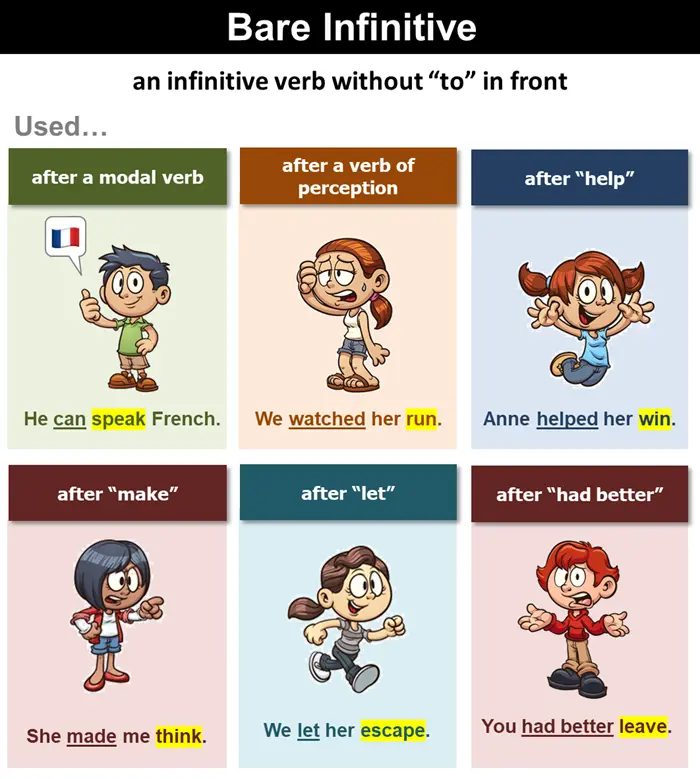
Bare infinitive:
Key Situations Where Bare Infinitives Are Used:
1. After Modal Verbs:
Bare infinitives are used after modal verbs such as can, could, may, might, must, shall, should, will, would.
Examples:
She can swim very well. (swim is a bare infinitive following can.)
You must leave now. (leave is a bare infinitive following must.)
They should study for the test. (study is a bare infinitive following should.)
2. After Verbs of Perception:
Bare infinitives are used after verbs of perception like see, hear, feel, watch, etc., especially when describing the action as a complete event or process.
Examples:
I saw her run across the street. (run is a bare infinitive after saw.)
We heard him sing a beautiful song. (sing is a bare infinitive after heard.)
She felt the wind blow through her hair. (blow is a bare infinitive after felt.)
3. After Certain Verbs (Causative and Let)
Some verbs, especially causative verbs like make, let, and help, are followed by a bare infinitive.
Examples:
She made him apologize. (apologize is a bare infinitive after made.)
He let me drive his car. (drive is a bare infinitive after let.)
They helped us finish the project. (finish is a bare infinitive after helped.)
Note: Help can also be followed by the full infinitive (to finish), but the bare infinitive is more common in informal contexts.
4. After “Why” Questions:
In informal speech, when “why” is used to ask for a reason, it’s often followed by a bare infinitive instead of a full one.
Examples:
Why wait when we can start now? (wait is a bare infinitive after why.)
Why bother studying if you already know the material? (bother is a bare infinitive after why.)
5. In Certain Fixed Expressions:
Some idiomatic expressions and constructions use bare infinitives. This happens in phrases like rather than, sooner than, or after had better.
Examples:
You had better leave now. (leave is a bare infinitive after had better.)
I would rather stay home than go out. (stay is a bare infinitive after would rather.)
They’d sooner walk than take a taxi. (walk is a bare infinitive after sooner.)
6. After “Do” in Negative or Interrogative Sentences:
The bare infinitive is used after the auxiliary verb do in questions and negative sentences.
Examples:
I didn’t see him at the party. (see is a bare infinitive after didn’t.)
Do you want to join us? (want is a bare infinitive after do.
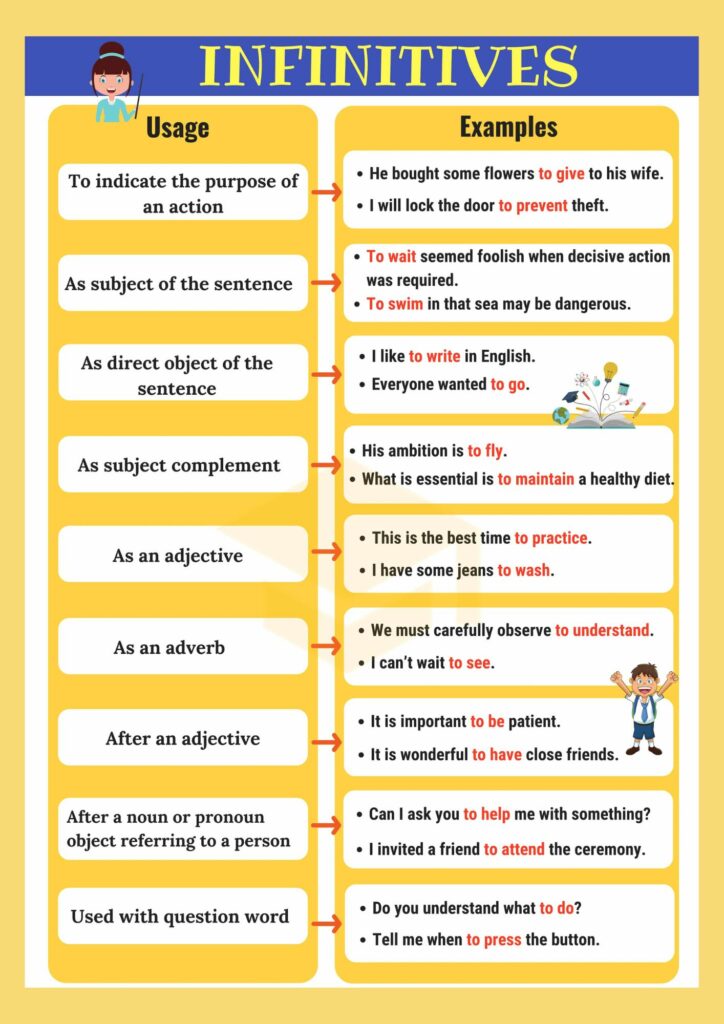
Functions of the Infinitive:
The infinitive can function in various ways within a sentence:
As a Subject: When the infinitive acts as the subject of a sentence.
Example: To travel is exciting.
As an Object: The infinitive can function as the object of a verb.
Example: She wants to dance.
As an Adjective: The infinitive can describe a noun.
Example: He has a plan to succeed.
As an Adverb: It can modify verbs, adjectives, or other adverbs, often expressing purpose.
Example: She went to the store to buy some groceries.
As a Complement: The infinitive can complement the meaning of certain verbs, nouns, or adjectives.
Example: They were happy to see her.
Common Uses of the Infinitive:
Expressing Purpose: Infinitives often express the reason or purpose behind an action.
Example: She studies hard to pass her exams.
After Certain Verbs: Some verbs are typically followed by an infinitive.
Example: They decided to go home.
After Adjectives: Infinitives often follow adjectives to express reasons or give explanations.
Example: It’s difficult to explain.
In Fixed Expressions: Infinitives are part of many fixed expressions.
Example: To be or not to be, that is the question.
Infinitive Phrases: Infinitives can form phrases that function as a unit within a sentence.
Example: To finish the project on time, we need to work harder.
Split Infinitives:
A split infinitive occurs when an adverb or other word is inserted between “to” and the verb.
Example: She decided to quickly run to the store.
While split infinitives were once considered grammatically incorrect, they are now generally accepted in modern English, especially when they improve the clarity or flow of a sentence.
Some Verbs That Always Take the Bare Infinitive:
Some verbs such as ‘make’, ‘do’ and ‘let’ always take the bare infinitive form of the verb. For example,
Let me know if you need some help.
Windy does not like brinjal and bitter gourd.
The teacher made the students speak about their trip in one minute.
Some Verbs That Always Take the Full Infinitive:
There is a list of verbs in English that are always followed by the ‘to-infinitive’ when they have a verb form following them. Here is the list of 35+ verbs. Check it out.
Agree
Need
Ought
Care
Beg
Appear
Choose
Resolve
Ensure
Decide
Plan
Wish
Want
Aim
Mean
Like
Love
Hate
Deserve
Learn
Proceed
Attempt
Claim
Forget
Remember
Demand
Long
Promise
Threaten
Hesitate
Expect
Hope
Prepare
Offer
Seem
Refuse
Tend
In English, infinitive verbs (the “to” form of the verb, like “to run,” “to eat,” etc.) can often function as nouns. When an infinitive verb acts as a noun, it refers to the action itself, and it can take the place of a subject, object, or complement in a sentence.
Functions of an Infinitive Verb – Usage and Examples:
An infinitive verb can perform three main roles – the roles of a noun, an adverb and an adjective. Let us learn how this particular form is used in sentences.
Here are some examples of infinitive verbs being used as nouns:
Subject of a sentence:
To swim is fun.
(“To swim” is functioning as the subject of the sentence.)
Object of a verb:
He likes to read.
(“To read” is the object of the verb “likes.”)
Object of a preposition:
She is excited about to travel next summer.
(“To travel” is the object of the preposition “about.”)
Complement:
His dream is to become a doctor.
(“To become” complements the verb “is” by describing what his dream is.)
Infinitive verbs can also function as adjectives in English. When used this way, they modify or describe a noun by expressing the purpose or intention related to that noun.
Here are some examples of infinitive verbs used as adjectives:
Modifying a noun:
She has a lot of work to do.
(“To do” describes the noun “work” by explaining what kind of work it is.)
Expressing purpose or necessity:
I need a book to read.
(“To read” modifies “book,” explaining what kind of book is needed.)
Clarifying or adding information:
This is the best place to eat.
(“To eat” modifies the noun “place” by explaining its purpose.)
Infinitive verbs can also function as adverbs, modifying verbs, adjectives, or other adverbs. When used as adverbs, infinitives often express purpose, reason, or intention, answering questions like “Why?” or “For what purpose?”
Here are some examples of infinitive verbs used as adverbs:
Modifying a verb (expressing purpose or reason):
She studies hard to pass the exam.
(“To pass” explains why she studies hard, expressing the purpose of the action.)
Modifying an adjective:
He is eager to learn.
(“To learn” modifies the adjective “eager,” explaining why he is eager.)
Modifying an adverb:
She ran quickly to catch the bus.
(“To catch” modifies the adverb “quickly,” explaining why she ran quickly.)
Infinitive vs. Infinitive Phrase:
Infinitives include to and a verb. Infinitive phrases include more words after the verb to provide detail.
Paul really wanted to sleep all night.
It’s my money to spend on what I want.
We returned to help our friends.\
Sentence Examples of Verbs Followed by Infinitives:
You’ve probably seen more infinitives than you think in your everyday reading. Find which common verbs are often paired with infinitives in the chart below.
Verb
Example Sentence
afford
We can’t afford to eat out every night.
agree
Let’s agree to disagree.
aim
I aim to please.
appear
She appears to have chicken pox.
arrange
I’ll arrange to meet you at 3:00
attempt
We’ll attempt to contact you again.
beg
She begged to stay up past her bedtime.
care
Would you care to dance?
choose
He’ll always choose to eat pizza
claim
They claim to have a winning lottery ticket.
dare
Do you dare to question me?
decide
We decided to move next month.
demand
I demand to know who said that!
deserve
You deserve to have all you want in life.
expect
Do you expect to see her again?
fail
She failed to achieve her goals.
happen
I happen to have all the things you need
hesitate
He hesitated to ask for the day off.
hope
She hopes to graduate this year.
learn
We’re learning to communicate better.
long
He longed to hold her in his arms.
manage
Have you managed to complete your work?
mean
I didn’t mean to hurt you.
need
You need to think before you speak.
neglect
He neglected to tell his parents.
offer
Jim offered to help me pack.
plan
What do you plan to do after college?
prepare
I’m preparing to run away.
pretend
Don’t pretend to sleep.
proceed
We proceeded to finish the movie.
promise
I promise to love you forever.
refuse
She refused to sign the documents.
resolve
He resolved never to fight again.
seem
They seem to be very happy.
swear
Do you swear to tell the truth?
tend
I tend to laugh when I’m nervous.
threaten
He threatened to quit his job.
use
What did you use to fix your trumpet?
volunteer
They volunteered to paint kids’ faces at the fair.
vow
We vowed to love and cherish one another.
want
Do you really want to hurt me?
wish
I wished to see my grandma again.
Conclusion:
The infinitive is a powerful and flexible grammatical structure that enhances the expressiveness of language. Whether used to indicate purpose, complement a verb, or function as a noun, adjective, or adverb, the infinitive is an essential part of English grammar. Understanding its forms and functions will help you use it effectively in both writing and speech.